Marathon splits: full chart from 2:45 to 5:30, every 5 miles
In a marathon, knowing your pace per mile is not enough: on race day, it is the splits at the 5-mile marks and at halfway that tell you at a glance whether you are on track. This chart gives the even-pace splits for ten goals, from 2:45 to 5:30, then explains how to adapt them to a slight negative split and use them on a pace band.
Marathon split chart, every 5 miles
Every time below is computed at a strictly even pace over 26.2 miles. The halfway split (13.1 miles) is exactly half the finish time.
| Goal | Per mile | Per km | Mile 5 | Mile 10 | Half | Mile 15 | Mile 20 | Mile 25 | Finish |
|---|---|---|---|---|---|---|---|---|---|
| 2:45 | 6:18 | 3:55 | 31:28 | 1:02:56 | 1:22:30 | 1:34:24 | 2:05:52 | 2:37:20 | 2:45:00 |
| 3:00 | 6:52 | 4:16 | 34:20 | 1:08:39 | 1:30:00 | 1:42:59 | 2:17:18 | 2:51:38 | 3:00:00 |
| 3:15 | 7:26 | 4:37 | 37:11 | 1:14:22 | 1:37:30 | 1:51:34 | 2:28:45 | 3:05:56 | 3:15:00 |
| 3:30 | 8:01 | 4:59 | 40:03 | 1:20:06 | 1:45:00 | 2:00:09 | 2:40:11 | 3:20:14 | 3:30:00 |
| 3:45 | 8:35 | 5:20 | 42:54 | 1:25:49 | 1:52:30 | 2:08:43 | 2:51:38 | 3:34:32 | 3:45:00 |
| 4:00 | 9:09 | 5:41 | 45:46 | 1:31:32 | 2:00:00 | 2:17:18 | 3:03:05 | 3:48:51 | 4:00:00 |
| 4:15 | 9:44 | 6:03 | 48:38 | 1:37:16 | 2:07:30 | 2:25:53 | 3:14:31 | 4:03:09 | 4:15:00 |
| 4:30 | 10:18 | 6:24 | 51:29 | 1:42:59 | 2:15:00 | 2:34:28 | 3:25:58 | 4:17:27 | 4:30:00 |
| 5:00 | 11:27 | 7:07 | 57:13 | 1:54:25 | 2:30:00 | 2:51:38 | 3:48:51 | 4:46:03 | 5:00:00 |
| 5:30 | 12:35 | 7:49 | 1:02:56 | 2:05:52 | 2:45:00 | 3:08:48 | 4:11:44 | 5:14:40 | 5:30:00 |
Paces are rounded to the second, splits are computed from the exact pace (for example 6:51.9 per mile for 3:00). For an in-between goal or a custom strategy, the marathon pace calculator gives your split for every mile.
How to read and use this chart
The halfway split, your main benchmark
Halfway is the one point where almost every race gives you an official intermediate time. Passing at exactly half your goal time means you are running an even split. To finish in 3:30, pass halfway in 1:45:00; for 4:00, in 2:00:00. If you pass more than 2 minutes ahead of a 3:30 goal, you probably ran the first miles too fast.
Miles 20 and 22: the moment of truth
The marathon wall plays out between mile 19 and mile 22. Compare your actual time with the chart at mile 20 and again at mile 25: if you lose less than 45 seconds per 5 miles, your pace is well judged. If you lose more than 1:30 per 5 miles, accept a revised goal rather than chasing a split that is now out of reach.
Each goal has its own page
For the vVO2max needed, the advised mileage and the plan for each time: 2:45 marathon, 3:00, 3:15, 3:30, 3:45, 4:00, 4:15, 4:30, 5:00 and 5:30.
Adapting the splits to a slight negative split
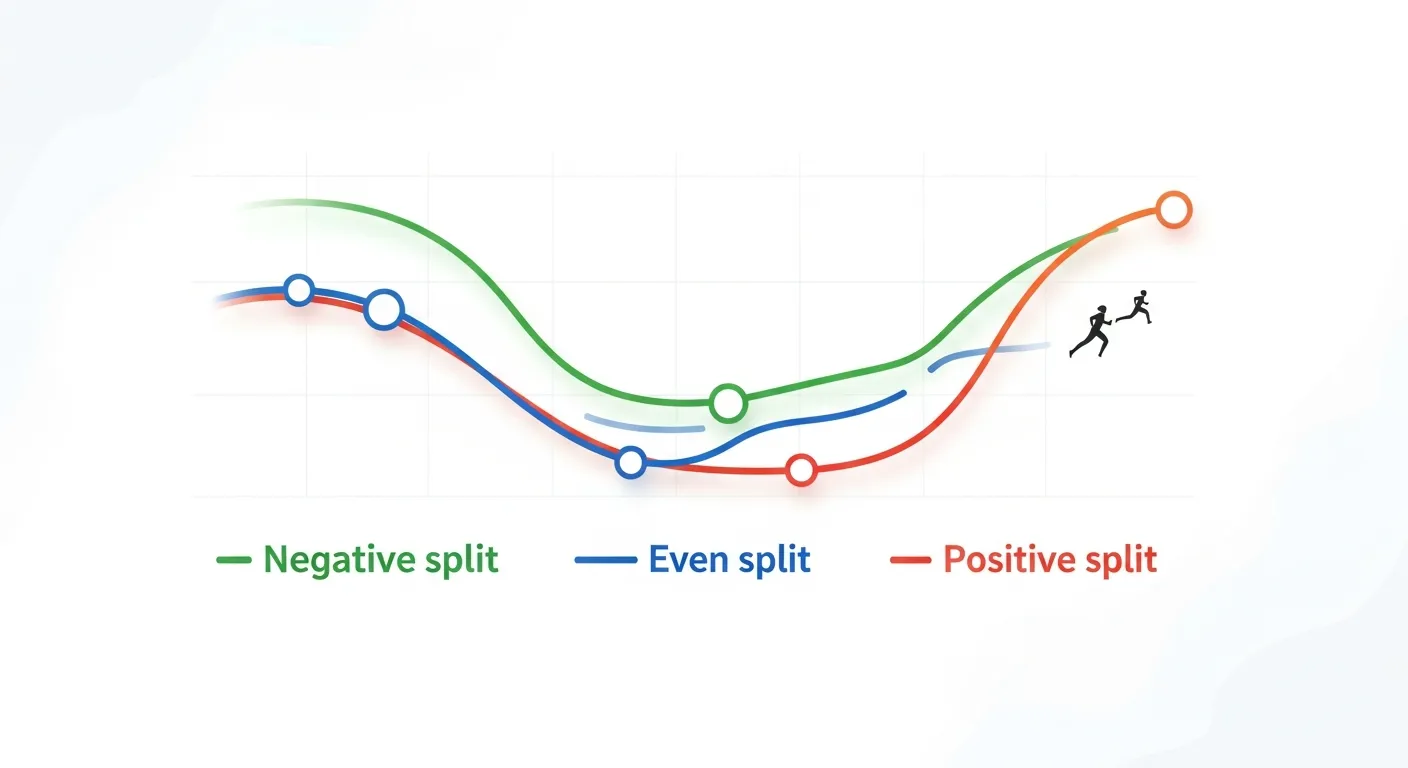
The chart above assumes an even pace. Yet many world records are run with a slight negative split: a first half 1 to 2% slower than the second. Amateurs, on the other hand, usually slow down in the second half. The full guide to race strategies compares the options; here is a 1% negative split for two common goals.
| Goal | Strategy | 10K | Half | Mile 20 | Finish |
|---|---|---|---|---|---|
| 3:30 | Even pace (8:01/mi) | 49:46 | 1:45:00 | 2:40:11 | 3:30:00 |
| 1% negative split (8:03 then 7:58/mi) | 50:01 | 1:45:31 | 2:40:26 | 3:30:00 | |
| 4:00 | Even pace (9:09/mi) | 56:53 | 2:00:00 | 3:03:05 | 4:00:00 |
| 1% negative split (9:12 then 9:06/mi) | 57:10 | 2:00:36 | 3:03:22 | 4:00:00 |
In practice, you pass halfway 30 to 40 seconds behind the even-pace chart, then make it up gradually after mile 15. The gap looks tiny, but it is often what separates a well-run marathon from a finish at 10:30 per mile.
Making your pace band
A pace band is a laminated strip of paper worn on the wrist, listing your target splits at the markers. It saves you doing math in the race, when clarity fades. To make one:
- Pick your goal in the chart, or print a mile-by-mile PDF band right away with the pace band generator (or get the splits from the marathon calculator).
- If you plan a negative split, add 15 to 20 seconds to the mile 5 and mile 10 splits and 30 to 40 seconds at halfway, then move back toward the chart values from mile 20.
- Write down the race time (your own watch started on the line), not the time of day: in a big race you may cross the start 10 minutes after the gun.
- Print in large type, laminate or cover with clear tape, and fix it with an elastic band or under your watch.
In big marathons (Berlin, Valencia, London, Paris), pacers run for round goals (3:00, 3:15, 3:30, 3:45, 4:00, 4:30). Following them is a sound option, but check their halfway split: a pacer 2 minutes ahead of the chart is taking you to the wall.
Aid stations and splits
Aid stations are often every 5 km in European marathons and more frequent in many US races: check your race's course map and build them into the plan:
- Walking 10 to 15 seconds to drink costs about 15 to 20 seconds per stop, or 2 to 3 minutes over a whole race with eight stops. Build it into your splits or accept being slightly behind at each marker.
- Take your gels just before an aid station so you can wash them down with water.
- Beyond 4 hours of running, alternate water and sports drink, and never skip the stations around mile 19 and mile 22, even if you feel good. Our guide to fueling during a race gives the amounts.
FAQ
What pace do I need for a 4-hour marathon?
A 4:00:00 marathon means an average pace of 9:09 per mile (5:41/km), or 6.6 mph. At an even pace you pass halfway in 2:00:00 and mile 20 in 3:03:05.
What halfway split for a 3:30 marathon?
At an even pace, you pass halfway in 1:45:00 to finish in 3:30. With a slight 1% negative split, aim for 1:45:30 at halfway and make up those 30 seconds over the last 10 miles.
Should I hit the splits to the second?
No. A tolerance of 15 to 25 seconds per 5 miles is normal and depends on the course, the wind and the aid stations. What matters is the trend: a steady drift behind the chart after mile 15 signals a starting pace that was too ambitious.
Do the splits change on a hilly course?
Yes. On a course with long climbs, such as the Newton hills of Boston or trail-style marathons, expect to lose 15 to 30 seconds per mile on a 3% climb and to get only part of it back downhill. Set splits by segment rather than every 5 miles, using the official course profile.
How do I work out a split that is not in the chart?
Divide your goal time in seconds by 26.219 to get the pace in seconds per mile, then multiply by the distance of the marker. For 3:50 (13,800 s): 13,800 ÷ 26.219 = 526 s per mile, so 8:46 per mile, and a mile 10 split of 1:27:43. The marathon pace calculator does it for you, with every mile.