Marathon goal pace: finding the right target

Choosing your marathon pace is the most important decision of the whole build. A pace that is too ambitious is paid for after mile 19 with a collapse that costs 10, 20, sometimes 30 minutes; a pace that is too cautious leaves regrets but rarely more than 5 minutes. This guide gives the benchmarks by level, the splits of common goals and three estimation methods: from the half marathon, from vVO2max and from a test session.
Why marathon pace is a pace apart
Over a 10K or a half, a pacing mistake means a painful finish. In a marathon it can mean the wall: a model of the metabolic factors of the marathon (Rapoport, 2010) shows that a trained runner's glycogen stores last, at marathon pace, for a distance in the order of 30 km (about 19 miles), and that every extra percent of intensity brings the depletion point closer. An analysis of several million amateur marathon results (Smyth, 2021) confirms that the runners who hit the wall are overwhelmingly those who ran the first half faster than their potential. For a trained runner, marathon pace is about 76 to 82% of vVO2max: a pace you should be able to hold breathing through your nose for the first miles.
Reference times by level
Benchmarks observed in French marathons for adults aged 20 to 50. For comparison, the world records listed by World Athletics are under 2:01 for men and under 2:10 for women.
| Level | Men | Women | Pace, men (per mile) | Pace, women (per mile) |
|---|---|---|---|---|
| Beginner | 4:30-5:30 | 4:45-5:45 | 10:18-12:35 | 10:52-13:10 |
| Intermediate | 3:45-4:30 | 4:00-4:45 | 8:35-10:18 | 9:09-10:52 |
| Advanced | 3:15-3:45 | 3:30-4:00 | 7:26-8:35 | 8:01-9:09 |
| Expert | 2:45-3:15 | 3:00-3:30 | 6:18-7:26 | 6:52-8:01 |
Common goals, paces and splits
The table gives the exact pace over 26.2 miles and the splits at mile 5, mile 10, halfway and mile 20 at an even pace. Each goal has its own page with the split for every mile.
| Goal | Pace per mile | Pace per km | Mile 5 | Mile 10 | Half | Mile 20 |
|---|---|---|---|---|---|---|
| 5:30 | 12:35 | 7:49 | 1:02:56 | 2:05:52 | 2:45:00 | 4:11:44 |
| 5:00 | 11:27 | 7:07 | 57:13 | 1:54:25 | 2:30:00 | 3:48:51 |
| 4:30 | 10:18 | 6:24 | 51:29 | 1:42:59 | 2:15:00 | 3:25:58 |
| 4:15 | 9:44 | 6:03 | 48:38 | 1:37:16 | 2:07:30 | 3:14:31 |
| 4:00 | 9:09 | 5:41 | 45:46 | 1:31:32 | 2:00:00 | 3:03:05 |
| 3:45 | 8:35 | 5:20 | 42:54 | 1:25:49 | 1:52:30 | 2:51:38 |
| 3:30 | 8:01 | 4:59 | 40:03 | 1:20:06 | 1:45:00 | 2:40:11 |
| 3:15 | 7:26 | 4:37 | 37:11 | 1:14:22 | 1:37:30 | 2:28:45 |
| 3:00 | 6:52 | 4:16 | 34:20 | 1:08:39 | 1:30:00 | 2:17:18 |
| 2:45 | 6:18 | 3:55 | 31:28 | 1:02:56 | 1:22:30 | 2:05:52 |
For an in-between goal (3:52, 4:10...), the marathon pace calculator gives the pace and every split.
Method 1: estimate your marathon from your half
A half marathon raced in the last three months is the best predictor. Multiply it by 2.1 if you run more than 37 miles a week and your long runs reach 19 miles, by 2.2 in the general case, and by 2.3 if your build is short or your mileage under 28 miles a week.
| Half time | Marathon (× 2.1) | Marathon (× 2.2) | Matching marathon pace per mile |
|---|---|---|---|
| 1:20 | 2:48 | 2:56 | 6:24 to 6:43 |
| 1:30 | 3:09 | 3:18 | 7:13 to 7:33 |
| 1:40 | 3:30 | 3:40 | 8:01 to 8:23 |
| 1:50 | 3:51 | 4:02 | 8:49 to 9:14 |
| 2:00 | 4:12 | 4:24 | 9:37 to 10:04 |
| 2:10 | 4:33 | 4:46 | 10:25 to 10:54 |
| 2:20 | 4:54 | 5:08 | 11:13 to 11:45 |
For a first marathon, use 2.2 and add 5 minutes of margin: better to finish 3 minutes under your goal than to hit the wall.
Method 2: estimate marathon pace from vVO2max
If you know your vVO2max from a field test, marathon pace sits around 80% of vVO2max for an experienced runner (under 3:30), 78% for an intermediate runner and 75% for a runner aiming beyond 4:30.
| vVO2max | Marathon pace (78%) | Estimated time | Pace at 80% | Estimated time |
|---|---|---|---|---|
| 7.5 mph (12 km/h) | 10:19/mi | 4:30 | 10:04/mi | 4:24 |
| 8.1 mph (13 km/h) | 9:31/mi | 4:10 | 9:17/mi | 4:03 |
| 8.7 mph (14 km/h) | 8:51/mi | 3:52 | 8:37/mi | 3:46 |
| 9.3 mph (15 km/h) | 8:15/mi | 3:36 | 8:03/mi | 3:31 |
| 9.9 mph (16 km/h) | 7:44/mi | 3:23 | 7:33/mi | 3:18 |
| 10.6 mph (17 km/h) | 7:17/mi | 3:11 | 7:06/mi | 3:06 |
| 11.2 mph (18 km/h) | 6:53/mi | 3:00 | 6:42/mi | 2:56 |
| 11.8 mph (19 km/h) | 6:31/mi | 2:51 | 6:21/mi | 2:47 |
This method assumes well-developed endurance: two runners with the same vVO2max can be 30 minutes apart in a marathon depending on their training volume. vVO2max sets a ceiling; easy running and the long run decide how far below it you land.
Method 3: confirm with a test session
Three to four weeks before the marathon, within a 19 to 20-mile long run, run the last 9 to 12 miles at your goal marathon pace. If you hold the pace without drifting and your heart rate stays stable, the goal is confirmed. If you lose more than 15 seconds per mile over the last 3 miles, move the goal 5 to 10 minutes slower. An all-out half marathon 4 weeks before, multiplied by 2.15, gives the same information with a safety margin.
From goal pace to race strategy
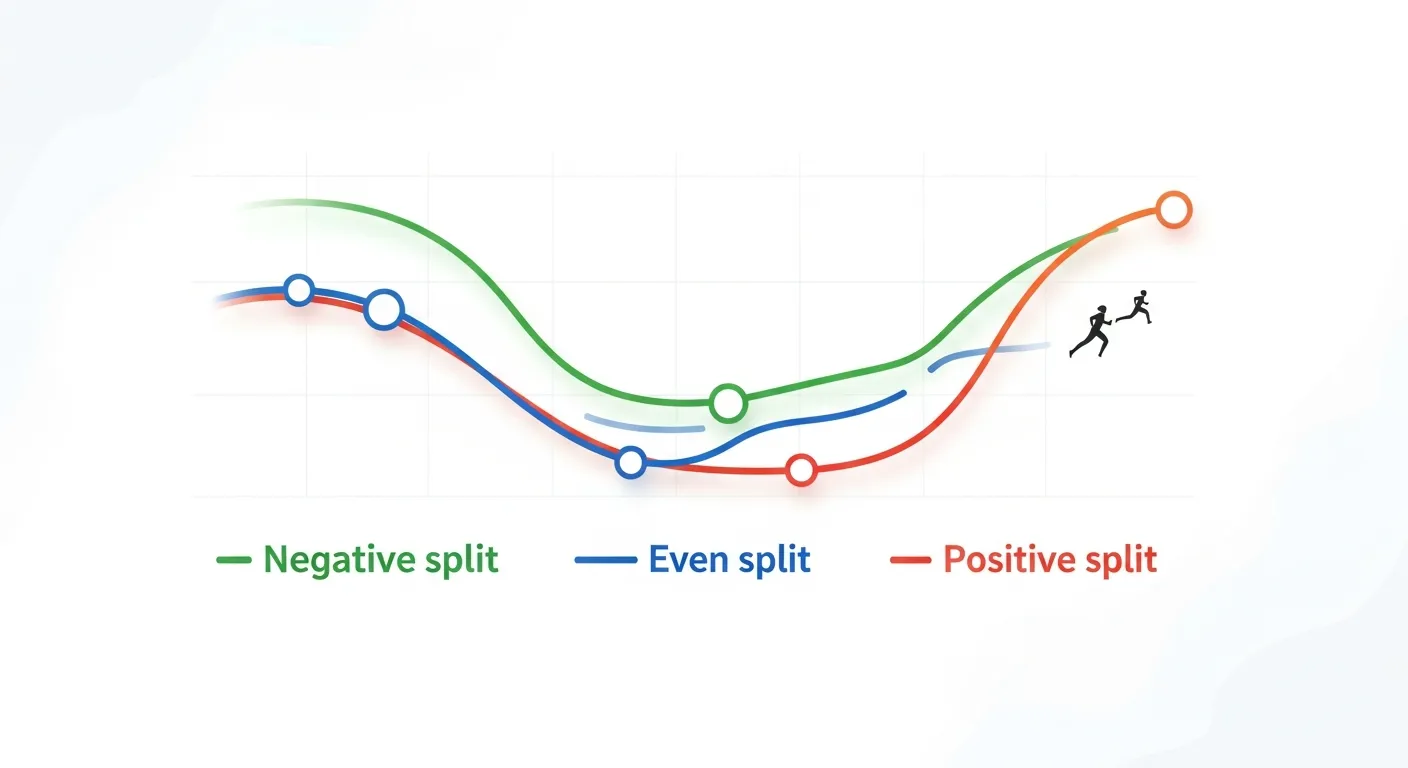
Goal pace is an average, not an instruction for the first mile. The pattern that produces the best amateur times is a start 10 to 15 seconds per mile slower than goal pace for the first 6 miles, strict goal pace from mile 6 to mile 19, then holding on or slightly speeding up at the end. For a 4-hour goal, that means 9:20 per mile at the start, 9:09 in the middle and, if all goes well, 8:59 over the last 3 miles. The three strategies are compared in our article on the negative split, and the causes of the wall in the marathon wall. To turn the goal into a plan, read the guide how to train for a marathon.
FAQ: marathon goal pace
What pace for a 4-hour marathon?
You need to hold 9:09 per mile (5:41/km), or 6.6 mph, passing halfway in 2:00:00 and mile 20 in 3:03:05. Start around 9:20 per mile for the first 6 miles, then settle on 9:09. This goal usually matches a half marathon run between 1:49 and 1:54 and a vVO2max of 8.1 to 8.7 mph.
What pace for a 3:30 marathon?
The average pace is 8:01 per mile (4:59/km), or 7.5 mph, passing halfway in 1:45 and mile 20 in 2:40:11. It is the typical goal of a runner worth 1:35 to 1:40 in the half who runs 34 to 43 miles a week. The pace is 78 to 80% of a vVO2max of 9.3 to 9.6 mph.
How do I predict my marathon time from my half?
Multiply your best recent half marathon time by 2.2 in the general case, by 2.1 if you run more than 37 miles a week with 19-mile long runs, by 2.3 if your mileage is low. A 1:50 half therefore gives a marathon between 3:51 and 4:02: a 4-hour goal makes sense, with a small safety cushion.
What is a good marathon time?
For a regular recreational runner, breaking 4 hours is considered a good level and breaking 3:30 an advanced level. Under 3 hours, you are among the expert runners, a very small share of finishers. For a first marathon, finishing while still running, without a collapse, is already a success whatever the time.
Should I run the same pace from start to finish?
An even pace or a slight negative split gives the best results. In practice, start 10 to 15 seconds per mile slower than goal pace for the first 6 miles, then hold goal pace to mile 19. If you have reserves left, speed up slightly at the end. Starting faster than goal pace is the first cause of failure in a marathon.
Related tools
Sources
- Rapoport BI (2010). Metabolic factors limiting performance in marathon runners. PLoS Comput Biol. 2010;6(10):e1000960. Link
- Smyth B (2021). How recreational marathon runners hit the wall: A large-scale data analysis of late-race pacing collapse in the marathon. PLoS One. 2021;16(5):e0251513. Link
- World Athletics (2026). World records by category (route, marathon). Link