Negative split, positive split and even split: the complete guide to race pacing
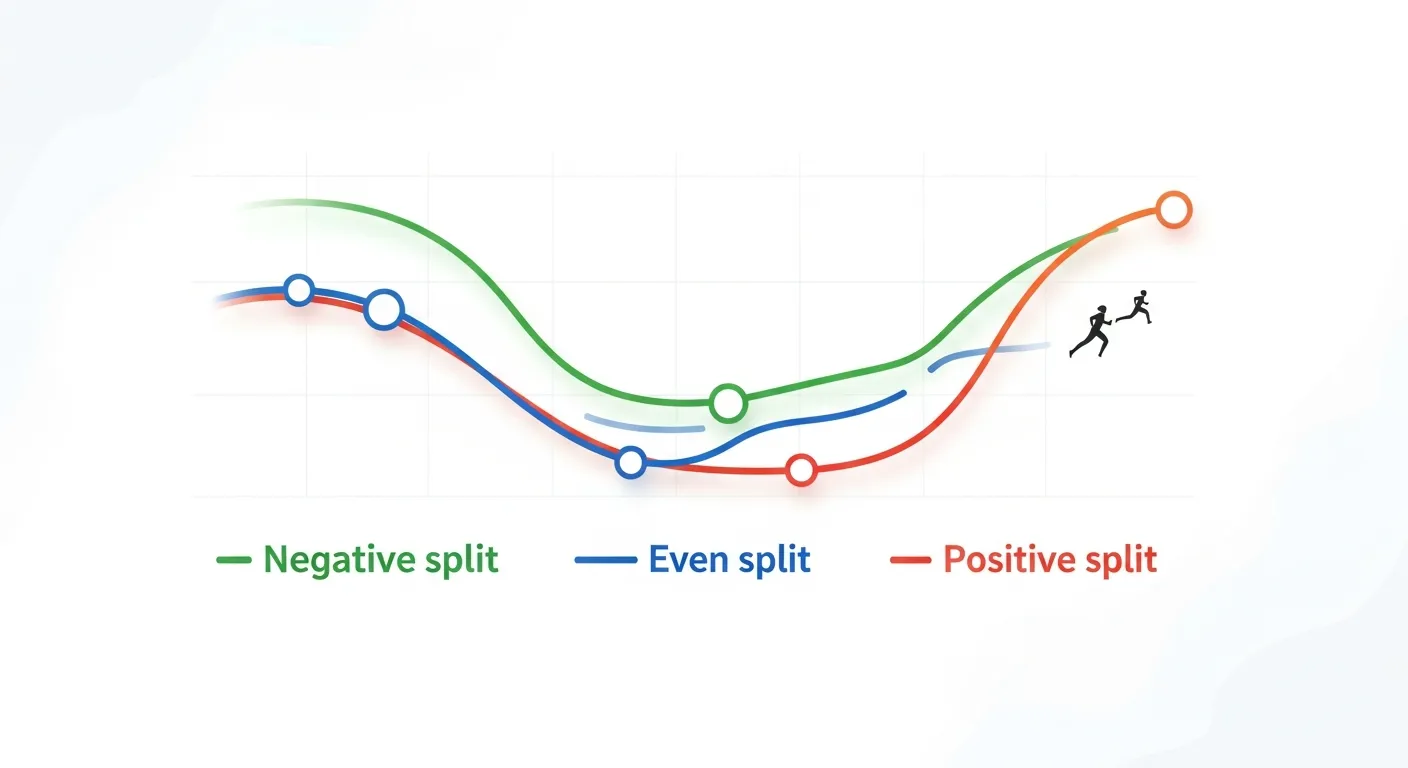
Pacing is one of the most decisive factors of a good race. Whether you are chasing a 10K personal best or your first marathon, the way you spread your effort between start and finish can make the difference between a great time and a painful last stretch. This guide compares the three main strategies, negative split, positive split and even split, with concrete data, worked numbers and training tips.
The three pacing strategies
Negative split: a faster second half
A negative split means running the second half of the race faster than the first. The runner starts cautiously, builds up gradually and finishes strong. It is the strategy coaches recommend most and the one used in most world records.
Pros:
- A gradual warm-up of the body (muscles, heart, breathing)
- Optimal use of glycogen: stores last longer
- A mental boost in the second half: you pass other runners and confidence grows
- Much lower risk of hitting the wall in a marathon
Cons:
- Takes strong discipline at the start (resisting adrenaline and the pack)
- Hard to judge without experience: start too slow and the finish time suffers
- Requires knowing your goal pace well
Even split: a steady pace
An even split means holding the same pace from the first mile to the last. It is the most energy-efficient strategy and the easiest to plan.
Pros:
- Optimal energy use, no peaks, no dips
- Easy to follow with a GPS watch set to goal pace
- Suits every distance, from the 5K to the marathon
Cons:
- In practice, a perfectly constant pace is rare (hills, wind, fatigue)
- Less margin to speed up at the end
Positive split: a faster first half
A positive split happens when the first half is faster than the second. It is the most common race trap: adrenaline sends you off fast, then you slow down.
Pros:
- Building a lead early (useful in pure tactics, not for time)
- Can work over short distances (5K) for very experienced runners
Cons:
- Fast lactate buildup and an early oxygen debt
- Faster glycogen depletion
- High risk of hitting the wall in a marathon (after mile 19)
- Mental frustration when the pace inevitably drops
The 3 strategies compared
| Criterion | Negative split | Even split | Positive split |
|---|---|---|---|
| For whom? | Experienced runners with a time goal | All levels, first race at the distance | Beginners (often unintended), tactical races |
| Best distance | Half marathon, marathon | Every distance | 5K (if controlled) |
| Risk of the wall | Very low | Low | High |
| Mental difficulty | High at the start (patience) | Moderate | High at the end (suffering) |
| Record times? | Yes (most road records) | Yes (5000 m, 10,000 m) | The norm in the 800 m; rare on the road |
Worked example: 4-hour marathon
Average goal pace: 9:09 per mile (5:41/km). Here is how the paces are spread with each strategy.
| Stretch | Negative split | Even split | Positive split |
|---|---|---|---|
| Km 1 to 5 (to mile 3.1) | 9:23/mi | 9:09/mi | 8:43/mi |
| Km 6 to 15 (to mile 9.3) | 9:15/mi | 9:09/mi | 8:54/mi |
| Km 16 to 25 (to mile 15.5) | 9:09/mi | 9:09/mi | 9:09/mi |
| Km 26 to 35 (to mile 21.7) | 8:59/mi | 9:09/mi | 9:26/mi |
| Km 36 to 42.2 (to the finish) | 8:48/mi | 9:09/mi | 9:55/mi |
| Finish time | ≈ 3:59 | ≈ 3:59:50 | ≈ 4:03 |
The positive split costs about 3 to 4 minutes compared with a well-run negative split, for a similar perceived effort. The mistake costs even more in a marathon than over shorter distances because of the wall.
Worked example: 1:45 half marathon
Average goal pace: 8:00 per mile (4:58/km).
| Stretch | Negative split | Even split | Positive split |
|---|---|---|---|
| Km 1 to 5 | 8:12/mi | 8:00/mi | 7:39/mi |
| Km 6 to 10 | 8:03/mi | 8:00/mi | 7:50/mi |
| Km 11 to 15 | 7:55/mi | 8:00/mi | 8:06/mi |
| Km 16 to 21.1 | 7:43/mi | 8:00/mi | 8:27/mi |
| Finish time | ≈ 1:44:30 | ≈ 1:44:50 | ≈ 1:46:10 |
Worked example: 50-minute 10K
Average goal pace: 8:03 per mile (5:00/km).
| Stretch | Negative split | Even split | Positive split |
|---|---|---|---|
| Km 1 to 3 | 8:12/mi | 8:03/mi | 7:43/mi |
| Km 4 to 7 | 8:03/mi | 8:03/mi | 8:03/mi |
| Km 8 to 10 | 7:50/mi | 8:03/mi | 8:27/mi |
| Finish time | ≈ 49:50 | ≈ 50:00 | ≈ 50:25 |
Over 10K, the gap between strategies is smaller (30 to 40 seconds) because the distance is short. The negative split pays off mostly from the half marathon up.
What the records and race data say
Among elites, everything happens within ±2.5%
On the road, recent world records are run at an almost even pace, often with a slightly faster second half:
| Race | Record | First half / second half | Gap |
|---|---|---|---|
| 10K, Valencia 2020 | Rhonex Kipruto, 26:24 | 13:18 / 13:06 | -1.5% |
| Marathon, Chicago 2023 | Kelvin Kiptum, 2:00:35 | 60:48 / 59:47 | -1.7% |
| Marathon, London 2026 | Sabastian Sawe, 1:59:30 | 60:29 / 59:01 | -2.4% |
| Marathon, Berlin 2022 | Eliud Kipchoge, 2:01:09 | 59:51 / 61:18 | +2.4% |
Two lessons. The elite negative split is small: no modern record comes close to -5%. And it is not mandatory: Kipchoge broke the world record in 2022 with a second half 1:27 slower. In the 5000 m and 10,000 m, the analysis of world records (Tucker et al., 2006) shows a U shape: faster first and last kilometers, a perfectly even middle.
On the track, the 800 m is the exception
In the 800 m, a positive split is the norm, not a mistake: 92% of the men's world records studied by Tucker et al. have a faster first lap (52.0 s against 54.4 s on average). David Rudisha set his 1:40.91 record in 2012 with laps of 49.28 and 51.63. In championships, Hanley et al. (2019) describe a "seahorse" profile: fast start, dip, surge, and a final 100 m that is the slowest. The 1500 m is the opposite: finals are run with a negative split and a fast last lap. The 800 m splits follow this four-phase profile; the 1500 m splits can be set from negative to positive.
Among amateurs, the real problem is +15%
Across about 92,000 results from 14 US marathons, men ran the second half 15.6% slower than the first, women 11.7% (Deaner et al., 2015). Across 4.18 million results, 34% of marathoners "hit the wall", on average at kilometer 29.6 (mile 18.4), and lose 31 to 33 minutes (Smyth, 2021).
So the practical question is not choosing between -2% and 0%, it is avoiding +15%. A start 1 to 3% slower than goal pace, a steady middle and a faster finish over the last miles cover most of it.
How to train for a negative split
Progressive interval sessions
The principle is simple: finish every interval set faster than you started it.
- 10 × 400 m progressive: the first 3 at 90% of goal pace, the next 4 at goal pace, the last 3 at 105%. If you cannot speed up on the last ones, you started too fast.
- 6 × 1000 m descending: each 1000 m 2 to 3 seconds faster than the previous one. Constant recovery (2 min). It teaches your body to speed up when tired.
- Reverse pyramid: 1000 m + 800 m + 600 m + 400 m, faster and faster. Each segment demands one more gear.
Long run with a fast finish
The fast-finish long run is the best exercise to prepare a race-day negative split:
- Format: 70-80% of the run at an easy pace, then the remaining 20-30% at half marathon or marathon pace
- Marathon example: 15.5 miles, the first 11 at 9:39 per mile, then 4.5 at 8:51 per mile
- Half marathon example: 10 miles, the first 7 at 8:51 per mile, then 3 at 7:47 per mile
- It simulates late-race conditions: speeding up on legs that are already tired
Goal pace plus surge session
Run 5 to 7.5 miles at goal pace, then go straight into 1 to 2 miles 15 to 25 seconds per mile faster. This session teaches you to dig into your reserves once the effort is under way.
Common mistakes to avoid
Mistake 1: confusing a negative split with a slow start
An effective negative split means starting 10 to 15 seconds per mile slower than goal pace, not 45 seconds slower. If you start far too slowly, you will never get the time back, even with a strong finish.
Rule of thumb: your first mile should feel "comfortably fast": you could go faster, but you choose not to.
Mistake 2: getting carried away by the pack at the start
Start-line adrenaline, the crowd, the pack surging: everything pushes you out too fast. The first 3 miles are the most important of the race. If your watch shows a pace 25 to 30 seconds per mile faster than your goal, slow down at once. It is not losing time, it is investing in the rest of the race.
Mistake 3: never practicing negative splits in training
The negative split is a skill you train. If you have never practiced it, do not try it for the first time on race day. Start by adding progressive interval sessions and fast-finish long runs to your training.
Mistake 4: a negative split that is too big
A negative split of 2 to 3% is enough. Beyond 5%, the gap is too large: you lose too much time in the first half and catching up takes an outsized effort in the second.
Which strategy should you choose?
| Situation | Recommended strategy |
|---|---|
| First race at the distance | Even split: aim for consistency |
| Time goal in a half or a marathon | Slight negative split (−2 to −3%) |
| Hilly course | Even effort (not even pace) |
| Hot conditions (above 77°F / 25°C) | Negative split: start cautiously, your body heats up |
| 5K race | Even split or a very slight negative split |
| Race with no time goal | It does not matter: run by feel! |
Test your strategy with our tool
Our pace calculator includes a race strategy tool that simulates your pacing mile by mile. Move the slider between -3% (negative split) and a positive split whose limit depends on the distance (+5% for the 5K, +8% for the half, +16% for the marathon, to review a race that went wrong) and see your splits instantly.
- Marathon pace calculator: simulate your strategy over 26.2 miles
- Half marathon pace calculator: test a negative split over 13.1 miles
- 10K pace calculator: fine-tune how you spread the effort
Sources
- Tucker R, Lambert MI, Noakes TD (2006). An analysis of pacing strategies during men's world-record performances in track athletics. Int J Sports Physiol Perform. 2006;1(3):233-245. Link
- Hanley B, Stellingwerff T, Hettinga FJ (2019). Successful pacing profiles of Olympic and IAAF World Championship middle-distance runners across qualifying rounds and finals. Int J Sports Physiol Perform. 2019;14(7):894-901. Link
- Deaner RO, Carter RE, Joyner MJ, Hunter SK (2015). Men are more likely than women to slow in the marathon. Med Sci Sports Exerc. 2015;47(3):607-616. Link
- Smyth B (2021). How recreational marathon runners hit the wall: a large-scale data analysis of late-race pacing collapse in the marathon. PLoS One. 2021;16(5):e0251513. Link