How to avoid running injuries: 7 rules backed by research

Depending on the study, between 20 and 80% of distance runners get injured in a given year, depending on the definition used and the population studied (systematic review by van Gent et al., 2007, see sources). The range is wide, but the message is clear: injury is the most widely shared runner experience, far ahead of the podium. The good news is that most of these injuries are overuse injuries, caused by a training load the tissues have not had time to absorb. They do not come out of nowhere, and they can largely be prevented with a few simple rules.
Why runners get injured
Running is a sport of repeated impact: several thousand foot strikes per run, each with a ground reaction force of about two to three times body weight (Cavanagh and Lafortune, 1980). Muscles, tendons and bones adapt to this stress, but at very different speeds. Heart and lungs improve in a few weeks, muscles in a few months, tendons and bones over several months or even years. That gap is the trap: you feel able to run more because your breathing allows it, while your tendons are not keeping up yet.
Systematic reviews of risk factors (van der Worp et al., 2015; van Gent et al., 2007) agree on a few points: the main risk factor is an injury in the previous twelve months, followed by high weekly volume (especially in novices), increasing that volume too fast, and a short running history. Weight, age and sex play a smaller role that varies with the injury. In short: what you do with your training weeks matters far more than your build.
The most common injuries
The knee, the lower leg and the foot are the most affected sites, led by shin splints, Achilles tendinopathy, plantar fasciitis and patellofemoral pain (Lopes et al., 2012).
| Injury | Area | Main cause | Prevention |
|---|---|---|---|
| Shin splints | Inner edge of the shin | Volume raised too fast, beginners | Cautious progression, calf strengthening, shoes that are not worn out |
| Runner's knee (patellofemoral pain) | Front of the knee | Excess load, weak quads and hips | Quad and glute strengthening, slightly higher cadence |
| Achilles tendinopathy | Back of the ankle | Overload, sudden change of drop or speed | Eccentric calf strengthening, gradual progression |
| Plantar fasciitis | Heel, arch | Overload, stiff calves, hard surfaces | Calf mobility, foot strengthening, suitable shoes |
| IT band syndrome | Outside of the knee | Weak hips, rising volume | Glute and gluteus medius strengthening, varied routes |
| Stress fracture | Shin, metatarsals, pelvis | Bone overload, not eating enough | Rest, medical advice, adequate energy intake |
Almost all these injuries share one feature: pain appears gradually, first after running, then during, then in daily life. The earlier you act in that sequence, the faster you heal.
The 7 anti-injury rules
1. Increase load gradually
The famous 10% per week rule is a handy guide, not a guarantee: a randomized trial in beginners found no reduction in injuries with a program capped at +10% compared with a faster one (Buist et al., 2008). However, raising mileage by more than 30% from one week to the next clearly increases the risk of distance-related injuries such as shin splints or runner's knee (Nielsen et al., 2014). What matters is consistency: small, regular increases, and holding volume steady for two or three weeks after each step before taking the next.
2. Respect the 80/20 split
About 80% of your volume should be run at easy pace, a pace at which you can hold a conversation, and at most 20% at intensity (threshold, intervals). Runners who do every run "a bit too fast" pile up fatigue that neither muscles nor tendons can digest, with no extra benefit to performance.
3. Do strength training
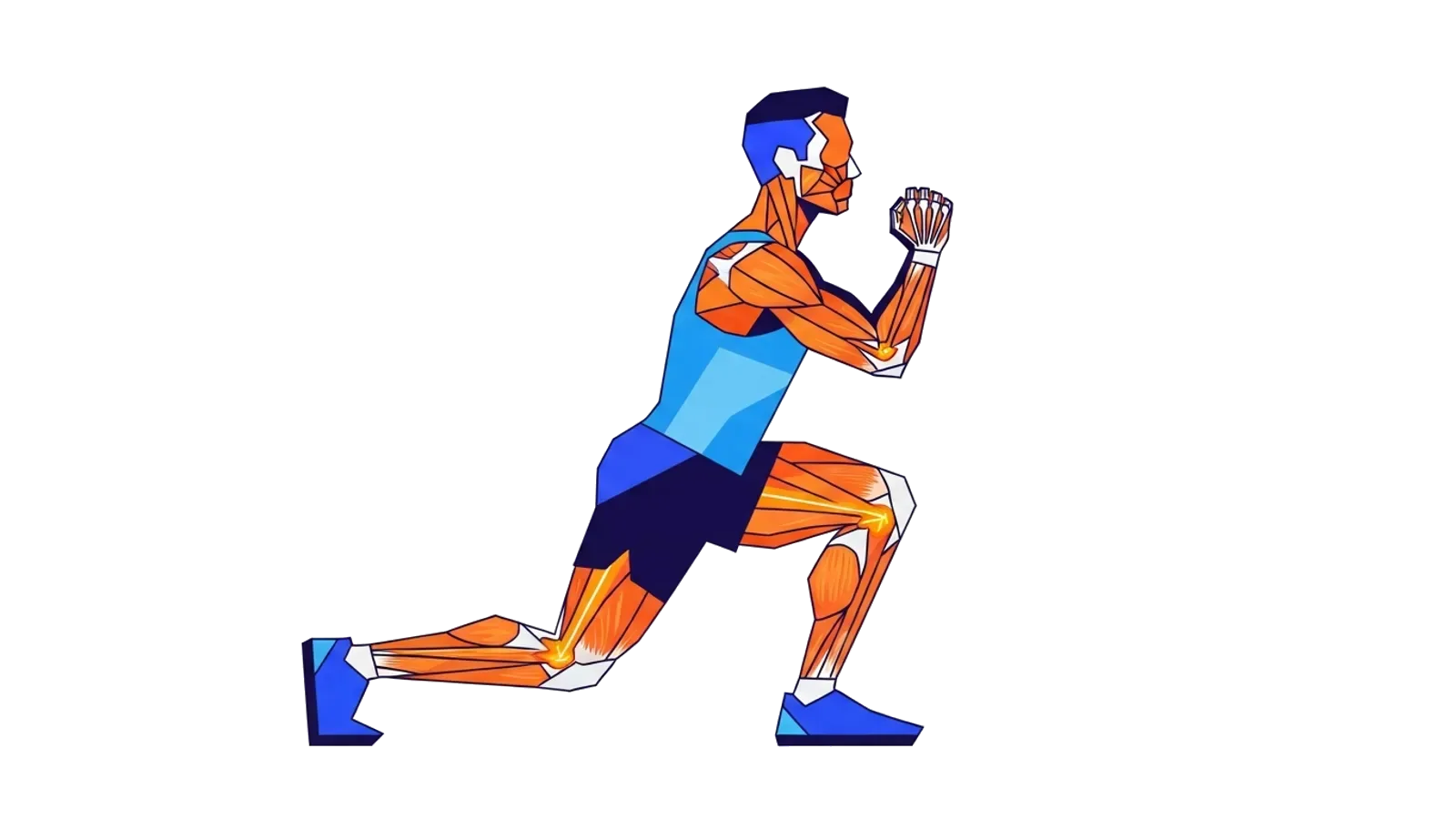
This is the best-documented intervention. A meta-analysis of 25 randomized trials (Lauersen et al., 2014) shows that strength work roughly halves overuse injuries in athletes. Two 15 to 20-minute sessions a week, with no equipment, are enough: lunges, single-leg squats, calf raises, core and hip work. Our 6 strength exercises for runners cover the essentials.
4. Schedule lighter weeks
Every 3 to 4 weeks, cut volume by 25 to 30% for a week. It is during this lighter week that the body absorbs the load of the previous weeks and gets stronger: that is the principle of supercompensation. Skipping it means stacking fatigue without ever banking the gains.
5. Sleep and eat enough
Energy intake that falls short of expenditure, deliberately or not, weakens bones and multiplies stress fractures, particularly in women. Short sleep also lowers your tolerance to load. If you lose weight without trying during a build, or your nights get shorter, take it seriously as a signal before pain shows up.
6. Choose comfortable shoes that are not worn out
Contrary to a common belief, no type of shoe has been shown to reduce injuries in all runners; the most reliable criterion remains perceived comfort (Nigg et al., 2015). What is well established, though, is that switching abruptly to a different category (drop, cushioning, minimalism) stresses the tendons, and that foam crushed after 370 to 560 miles (600 to 900 km) absorbs very little. Our guide on how to choose running shoes details these criteria.
7. Listen to the signals, and act early
Discomfort that goes away during the warm-up and does not come back the next day can be monitored. Pain that settles in over three runs in a row, lingers when walking or makes you change your stride means cutting load immediately, and seeing someone if it does not improve within one to two weeks. Runners who "grit their teeth" turn two-week injuries into three-month ones.
Risky moments in a season
| Situation | Why it is risky | What to do |
|---|---|---|
| Returning after a break of more than 3 weeks | Fitness comes back fast, tendons do not | Restart at 50-60% of previous volume, no intensity for 2 weeks |
| Start of a marathon plan | Volume and long run rise at the same time | Build the base before the plan, do not rush the first weeks |
| Adding a weekly run | Fewer recovery days | Add a short easy run, not a quality session |
| New shoes or a new surface | Unusual stress on the tendons | Gradual transition, alternate with your old gear |
| The 3 weeks after a race | Muscle micro-damage not yet repaired | Active recovery, gradual return of intensity |
A structured plan with lighter weeks built in removes many of these traps. Our training plan generator builds the progression week by week for your goal.
What to do once you are injured
Cutting load does not mean stopping everything: for most overuse injuries, pain-free activity (cycling, swimming, walking, strength work) maintains fitness and speeds healing. However, localized bone pain, night pain or significant swelling call for prompt medical advice to rule out a stress fracture. For what comes next, our guide to returning to running after an injury details the steps.
FAQ: preventing running injuries
What is the most common running injury?
Systematic reviews put shin splints, Achilles tendinopathy, plantar fasciitis and runner's knee at the top, with the knee as the most affected site. They are all overuse injuries, caused by progressing too fast or by volume too high for what the tissues can absorb.
Should you stretch to avoid running injuries?
Scientific data do not show that passive stretching reduces injury risk in runners. It can improve comfort and mobility, but prevention depends far more on gradual training and strength work, whose effectiveness is proven. A gradual warm-up at an easy jog is still useful before hard sessions.
How many miles a week before you risk injury?
There is no universal threshold: risk depends mostly on how fast you reached your current volume and on your history. A runner who has done 37 miles a week for five years is less exposed than a beginner going from 6 to 15 miles in two weeks. Avoid weekly increases of more than 10 to 15% and hold each step.
Can shoes cause injuries?
A worn-out, uncomfortable shoe or one very different from the previous pair can contribute to an injury, especially to the Achilles tendon and calf when the drop changes. However, no shoe category protects every runner, and most of the risk comes from training load. Choose comfort, change gradually, and replace tired pairs.
Can you keep running with pain?
Mild discomfort that disappears during the warm-up and does not worsen from one run to the next is usually compatible with reduced running. Pain that increases during the effort, persists when walking or changes your stride means stopping and seeing a sports doctor or physical therapist if it does not improve within one to two weeks of relative rest.
Related tools
This information is educational and does not replace the advice of a sports doctor or a physical therapist. It was written by the Tempocito editors and has not been reviewed by a named health professional. The figures rely on the scientific and institutional sources listed at the end of the article.
If pain persists, gets worse, is intense or appears at rest, see a health professional.
Sources
- van Gent RN, Siem D, van Middelkoop M, van Os AG, Bierma-Zeinstra SM, Koes BW (2007). Incidence and determinants of lower extremity running injuries in long distance runners: a systematic review. Br J Sports Med. 2007;41(8):469-480. Link
- Lopes AD, Hespanhol Júnior LC, Yeung SS, Costa LO (2012). What are the main running-related musculoskeletal injuries? A systematic review. Sports Med. 2012;42(10):891-905. Link
- Nielsen RØ, Parner ET, Nohr EA, Sørensen H, Lind M, Rasmussen S (2014). Excessive progression in weekly running distance and risk of running-related injuries: an association which varies according to type of injury. J Orthop Sports Phys Ther. 2014;44(10):739-747. Link
- Buist I, Bredeweg SW, van Mechelen W, Lemmink KA, Pepping GJ, Diercks RL (2008). No effect of a graded training program on the number of running-related injuries in novice runners: a randomized controlled trial. Am J Sports Med. 2008;36(1):33-39. Link
- Lauersen JB, Bertelsen DM, Andersen LB (2014). The effectiveness of exercise interventions to prevent sports injuries: a systematic review and meta-analysis of randomised controlled trials. Br J Sports Med. 2014;48(11):871-877. Link
- van der Worp MP, ten Haaf DS, van Cingel R, de Wijer A, Nijhuis-van der Sanden MW, Staal JB (2015). Injuries in runners; a systematic review on risk factors and sex differences. PLoS One. 2015;10(2):e0114937. Link
- Nigg BM, Baltich J, Hoerzer S, Enders H (2015). Running shoes and running injuries: mythbusting and a proposal for two new paradigms: "preferred movement path" and "comfort filter". Br J Sports Med. 2015;49(20):1290-1294. Link
- Cavanagh PR, Lafortune MA (1980). Ground reaction forces in distance running. J Biomech. 1980;13(5):397-406. Link