How to choose running shoes
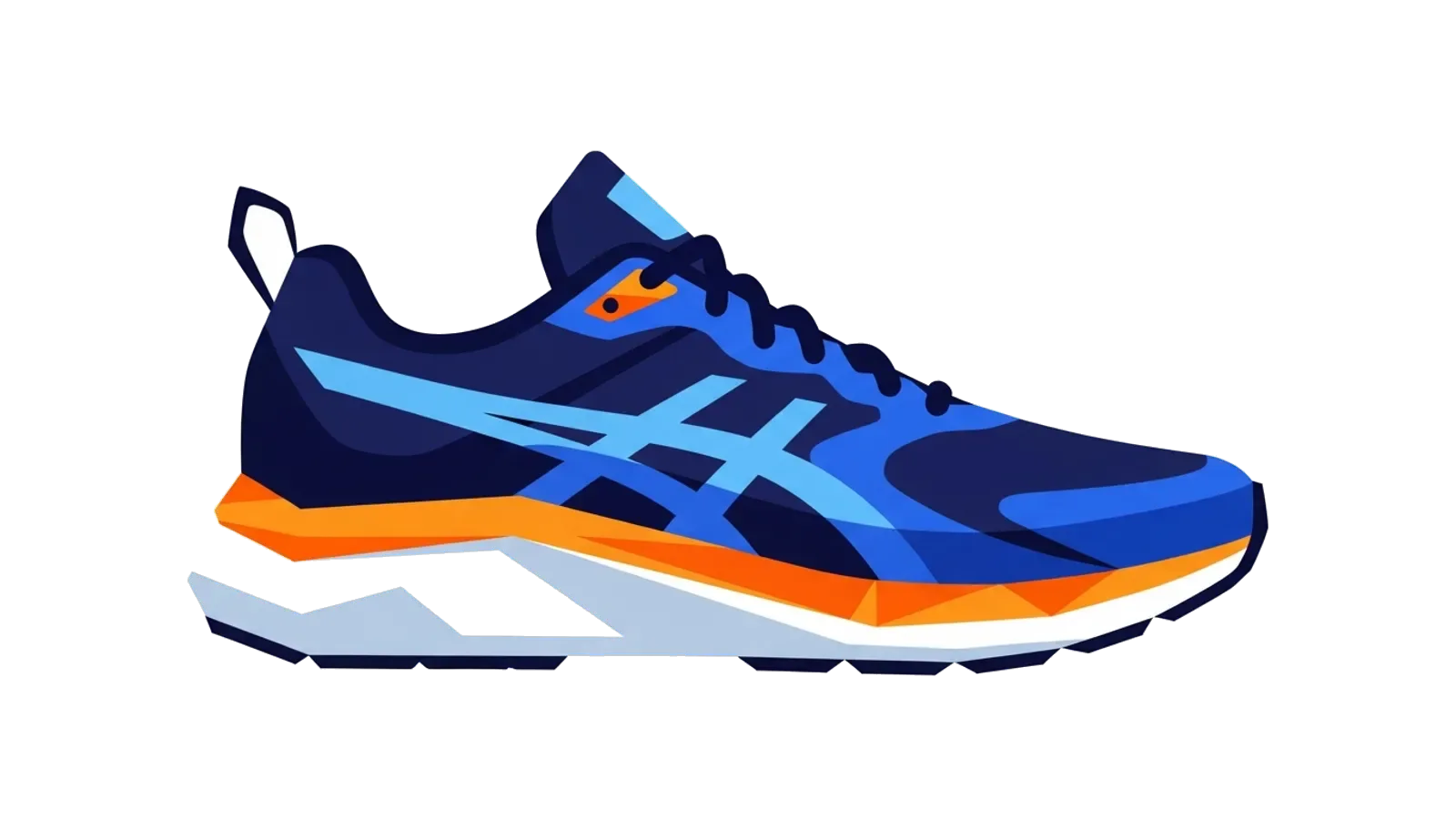
Shoes are the only truly essential piece of running gear, and the one that most directly affects comfort, performance and, to some extent, injury risk. The problem is that a running store now offers dozens of models, sorted by technical terms (drop, stack, stability, carbon plate) that mean little to most runners. This guide gives you a simple method to choose, starting from how you actually run rather than from marketing, and relying on what research knows, and does not know, about running shoes.
Start with how you run, not with the shoe
Before comparing models, answer four questions: how many miles a week do you run, on what surface, at what pace, and with what goal? A beginner running 10 miles a week on pavement does not have the same needs as a marathoner at 50 miles a week, or a trail runner. The grid below sums up the main shoe families and their use.
| Category | Main use | Cushioning | Typical drop | Typical weight (men's US 9) |
|---|---|---|---|---|
| Daily trainer | Easy runs, long runs, beginners, 80% of miles | Medium to high | 6-10 mm | 8.8-10.6 oz (250-300 g) |
| Max cushion | Long runs, heavier runners, recovery | Very high | 4-8 mm | 9.2-11.3 oz (260-320 g) |
| Stability (pronation support) | Runners with strong, bothersome pronation, for comfort | Medium to high | 8-12 mm | 9.5-11.3 oz (270-320 g) |
| Fast all-rounder (tempo) | Intervals, threshold, 10K to half marathon races | Medium, responsive foam | 4-8 mm | 7.1-8.8 oz (200-250 g) |
| Carbon-plated racer | Road races, 10K to marathon | High, very responsive foam | 6-8 mm | 6.3-8.1 oz (180-230 g) |
| Minimalist | Foot strengthening, gradual transition required | Low to none | 0-4 mm | 5.3-7.8 oz (150-220 g) |
| Trail | Paths, trails, mountains | Variable | 4-8 mm | 8.8-11.6 oz (250-330 g) |
For a runner who is starting out, the answer is almost always the same: a neutral daily trainer with medium cushioning. The other categories only become useful when mileage grows or a time goal appears. Our guide to starting to run from zero covers a beginner's minimum gear.
The technical criteria, explained simply
Drop
Drop is the height difference, in millimeters, between the heel and the forefoot. A high drop (10-12 mm) slightly unloads the Achilles tendon and the calf, and suits heel strikers. A low drop (0-4 mm) loads the back of the leg more and encourages a flatter or forefoot landing. No value is better in itself: what matters is not changing abruptly. Going from 10 mm to 4 mm overnight is a classic cause of Achilles tendinopathy or calf pain. If you want to lower your drop, do it in steps of 2 to 4 mm, alternating with your old pair for several weeks.
Cushioning and stack height
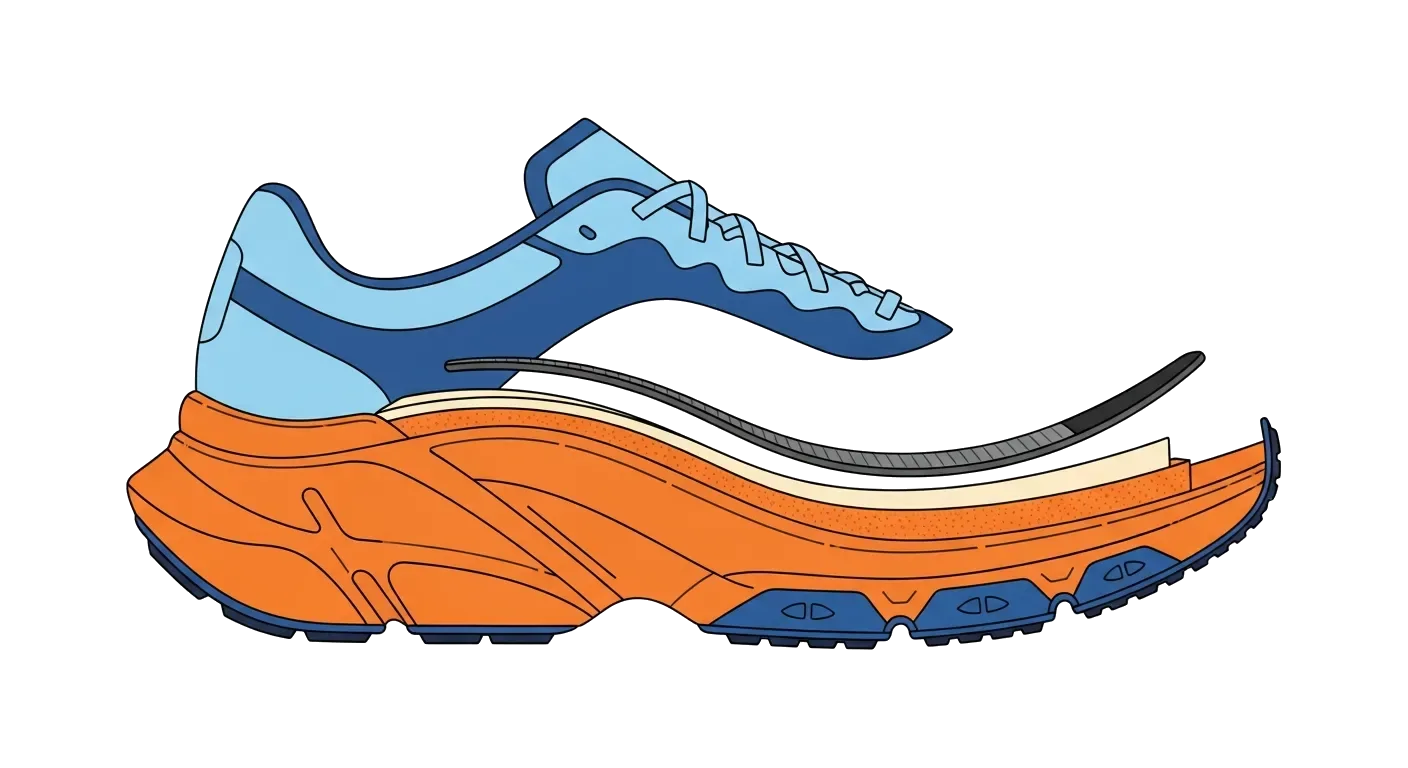
Cushioning is the midsole's ability to absorb impact, and stack is the total height of that midsole. Modern foams are both lighter and thicker than ten years ago. Plenty of cushioning brings comfort on long runs and for heavier runners; it also makes the shoe less stable and a little less precise. There is no solid evidence that more cushioning reduces injury risk: the review by Nigg et al. (2015) shows that neither cushioning nor pronation control has shown a systematic protective effect, and suggests relying first on perceived comfort, a simple criterion that seems linked to a lower injury risk.
Foot strike: pronation, supination, neutral
Pronation is the natural inward roll of the foot on landing that absorbs the shock; supination is the opposite movement. For decades, stores sorted runners into overpronators, supinators and neutral runners to prescribe a stability or neutral shoe. Recent research strongly qualifies this approach. A double-blind randomized trial on several hundred recreational runners (Malisoux et al., 2016) found that stability shoes reduced injury risk only in runners with marked pronation, and did nothing for the others. In other words: if you have no pain and your stride is not clearly pronated, a neutral shoe is the default. If you pronate strongly and have had knee or shin pain, a stability model may help, but comfort remains the first judge.
Weight
Every ounce counts at the end of your leg: running economy research shows that a lighter shoe lowers the energy cost of each stride, even if the effect stays modest. That is why racers weigh 6 to 8 oz against 9 to 10.5 oz for trainers. The downside: less material, so less cushioning and a shorter lifespan. Keep light shoes for fast sessions and races.
Size and foot shape
Your foot swells during a run and slides forward on downhills. Leave about a thumb's width (0.5 to 1 cm) between your longest toe and the front of the shoe, which often means half a size, or even a full size, above your everyday shoes. Try shoes on late in the day, with your running socks, and check that the forefoot is neither squeezed nor floating. The heel should be held without slipping. Some brands offer several widths: a decisive criterion for wide feet that should never be sacrificed to looks.
Which shoe for which goal?
| Your situation | First pair | Second pair (optional) |
|---|---|---|
| Beginner, 2-3 runs a week | Neutral daily trainer, medium cushioning | Not needed |
| 10K training with intervals | Daily trainer | Fast all-rounder for sessions and the race |
| Half or marathon training, 25 miles a week or more | Daily trainer, or max cushion for long runs | Racer (carbon or tempo) for goal pace and race day |
| Runner over about 190 lb (85-90 kg) | High cushioning, wide and stable sole | Same, in rotation |
| Coming back from an Achilles or calf injury | 8-10 mm drop, medium cushioning | Avoid low-drop models during the comeback |
| Trails and dirt paths | Trail shoe with suitable lugs | Road trainer for pavement |
Rotating two pairs is not a luxury for racers: alternating models varies the load on tendons and muscles, and gives the foams time to recover between runs. If you are training for a goal like a 1:45 half marathon or a 3:30 marathon, a second pair for fast paces becomes a sensible investment.
Do you need a carbon-plated shoe?
Racing shoes with a carbon plate and very responsive foam have upended records since 2017. The gain is real and measured: in the lab, the first such model lowered the energy cost of running by 4% on average compared with the best racing shoes of the time (Hoogkamer et al., 2018). On the clock the gain is smaller than those 4%, since part of the energy saved does not turn into speed, but it still counts in minutes over a marathon. It is not a gimmick. These shoes also have limits: a high price, a short lifespan, an instability that loads calves and feet heavily, and a benefit that varies a lot between runners. Keep them for races and a few goal-pace sessions, after a period of adaptation. Our article on carbon-plated super shoes explains how they work and when to avoid them.
Lifespan: when to replace your shoes
| Type | Typical mileage | Signs it is time to replace |
|---|---|---|
| Daily trainer | 375-560 mi (600-900 km) | Foam no longer bounces, outsole worn smooth at heel or forefoot, upper out of shape |
| Racer and tempo | 185-310 mi (300-500 km) | Clear loss of pop, deep creases in the foam |
| Carbon plate | 125-250 mi (200-400 km) | Packed-down foam, a "flat" feeling |
| Trail | 310-500 mi (500-800 km) | Rounded lugs, lost grip, damaged rock plate |
These figures vary with your weight, stride and surface. The most reliable signal is not the counter but new pains (knees, shins, arch) on ordinary runs: the foam has often died before the outsole. Note the purchase date and track mileage in your running app so you are not caught out.
How to try shoes in a store
- Go late in the day, with your running socks and, if you use them, your orthotics.
- Try at least three models from comparable categories, and run a few minutes in each (most running stores have a treadmill or let you run on the sidewalk).
- Trust immediate comfort: a shoe that bothers you on the first try will not "break in".
- Check the room at the front, the heel hold, the absence of irritating seams and the width.
- Be wary of simplified gait analyses that always end with a stability model: they are only useful if you have marked pronation or a history of injury.
- Never change shoes in the three weeks before a goal race.
The most frequent mistakes
- Buying too small: black toenails and blisters under the toes are the giveaway.
- Using a racing shoe every day: it wears fast and protects little on easy runs.
- Switching shoe type radically without a transition: drop, cushioning and stability should change gradually, or your tendons pay for it.
- Running in a dead pair "because it has no hole": the outsole almost always outlives the foam.
- Copying a friend's or a champion's shoe: their weight, stride and mileage are not yours.
- Forgetting the socks: a technical sock with no thick seams prevents many blisters wrongly blamed on the shoe.
A last reminder: shoes replace neither gradual training nor strength work. Most running injuries come from training load, not from the sole. To lower your risk, read our guide to avoiding running injuries too.
FAQ: choosing running shoes
What running shoe for a beginner?
A neutral daily trainer with medium cushioning and a 6 to 10 mm drop, chosen first for comfort and the right size. No need for a racing or stability model without a specific reason. A mid-range model is enough: the most expensive shoes of a line are not the best suited to beginners.
What drop should I choose?
If you have never had problems, stay in the 6 to 10 mm range, the most common and the most forgiving. A lower drop suits runners who land flat or on the forefoot and have strong calves; a higher drop unloads the Achilles tendon. Above all, never change drop by more than a few millimeters at once.
How many miles do running shoes last?
Between 375 and 560 miles for a daily trainer, 185 to 310 miles for a light racer, 125 to 250 miles for a carbon-plated model. Heavier runners and those who run mostly on pavement sit at the low end of these ranges. New pains on usual runs are the best signal to replace them.
Should running shoes be a size bigger?
Usually yes, half a size to a full size above your everyday shoes, to leave about a thumb's width in front of your toes. Your foot swells during a run and slides forward, especially downhill. Try shoes on late in the day and check that the heel stays well held despite the extra room at the front.
Are stability shoes useful if I overpronate?
Only if your pronation is marked and, ideally, if you have already had pain linked to that stride. A randomized trial found that stability shoes reduced injury risk only in runners with strong pronation. For mild pronation, which is very common and normal, a comfortable neutral shoe does just as well.
Related tools
Sources
- Nigg BM, Baltich J, Hoerzer S, Enders H (2015). Running shoes and running injuries: mythbusting and a proposal for two new paradigms: "preferred movement path" and "comfort filter". Br J Sports Med. 2015;49(20):1290-1294. Link
- Malisoux L, Chambon N, Delattre N, Gueguen N, Urhausen A, Theisen D (2016). Injury risk in runners using standard or motion control shoes: a randomised controlled trial with participant and assessor blinding. Br J Sports Med. 2016;50(8):481-487. Link
- Hoogkamer W, Kipp S, Frank JH, Farina EM, Luo G, Kram R (2018). A Comparison of the Energetic Cost of Running in Marathon Racing Shoes. Sports Med. 2018;48(4):1009-1019. Link