The sub-2-hour marathon: from Kipchoge in Vienna to Sabastian Sawe's first official sub-2

The first official sub-2-hour marathon was run on April 26, 2026 in London: Sabastian Sawe (Kenya) won in 1:59:30, ahead of Yomif Kejelcha (Ethiopia, 1:59:41). World Athletics ratified the record on July 23, 2026. Seven years earlier, Eliud Kipchoge had already run 1:59:40.2 in Vienna, but in a non-competitive exhibition that could not count as a record.
This article retraces that decade: why the 2-hour barrier fascinates, what such a pace means (4:33.5 per mile, 2:49.9 per km, for 26.2 miles), how Breaking2 and the INEOS 1:59 Challenge paved the way, and how the barrier finally fell in an official race.
2 hours: why such an obsession?
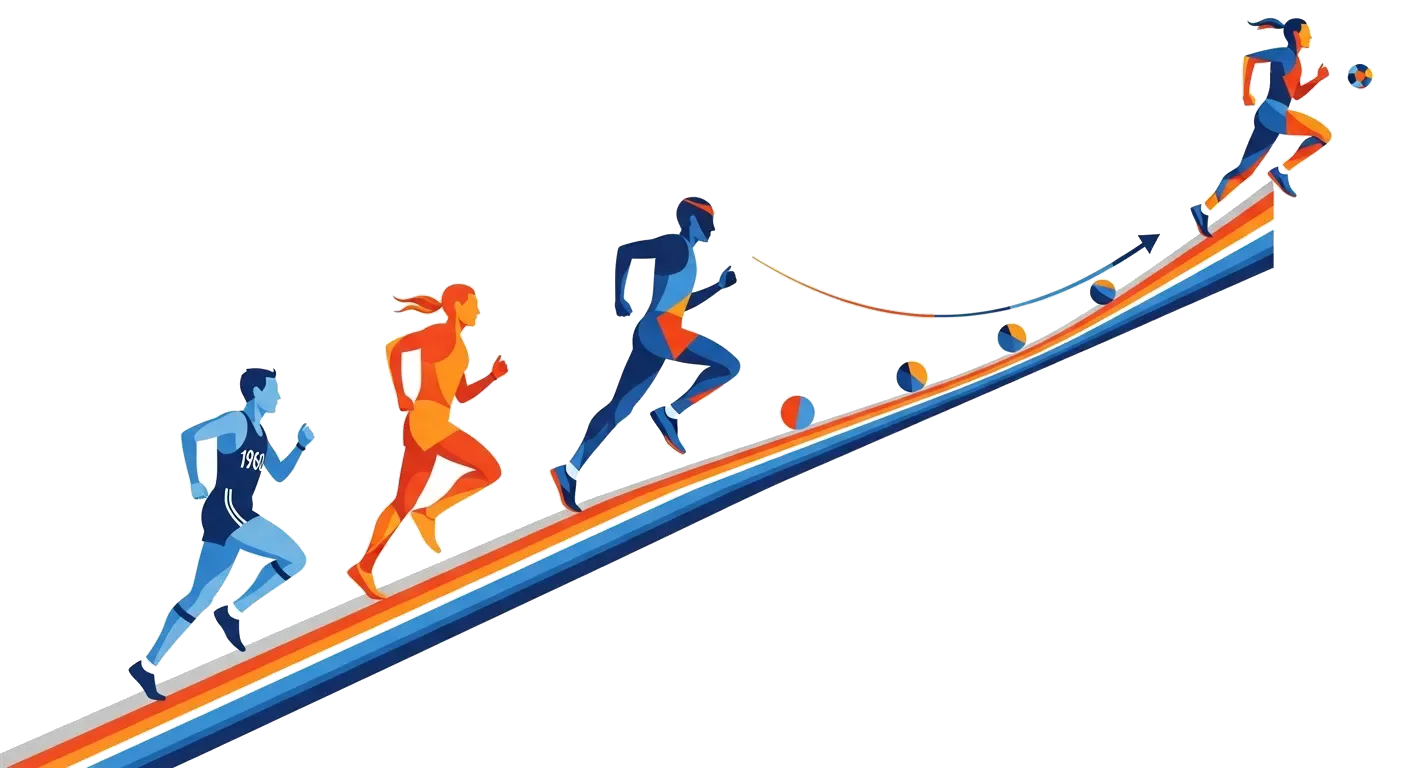
Big time barriers shape running: the sub-4-minute mile (Roger Bannister, 1954), the sub-2:10 marathon (Derek Clayton, 1969), sub-2:05 (Khalid Khannouchi, 1999), sub-2:03 (Patrick Makau, 2011). Each time, what seemed impossible became routine within a few years.
Two hours stood apart. In 1991, physiologist Michael Joyner calculated, from VO2max, running economy and lactate threshold, that a 1:57:58 marathon was theoretically possible. The record was then 2:06:50. Thirty-five years later, the official record stands at 1:59:30.
The two organized attempts: Breaking2, then INEOS 1:59
Two projects were designed to break the barrier free of the constraints of official races.
Breaking2 (Monza, May 6, 2017)
Nike brought Eliud Kipchoge, Lelisa Desisa and Zersenay Tadese to the Monza motor racing circuit: perfect surface, pacemakers in formation, drinks handed from a bike. Kipchoge finished in 2:00:25, 25 seconds short. No record possible, but proof that two hours was within human reach.
INEOS 1:59 Challenge (Vienna, October 12, 2019)
A new attempt, this time designed to succeed. A 6-mile (9.6 km) loop in Vienna's Prater park, 41 pacemakers in rotating teams in front of Kipchoge, a car projecting the target pace onto the road, drinks from a bike. Kipchoge finished in 1:59:40.2 and spoke his now famous line: "No human is limited".
Why Vienna 2019 was not a record
World Athletics sets several rules to ratify a road record:
- An open race, not a private attempt.
- No pacemakers joining and leaving during the race.
- Drinks from tables, not from a bike or a car.
- A measured, compliant course: the drop between start and finish must not exceed 1 m per km.
The INEOS 1:59 broke several of these criteria, on purpose. It still had to be done in an official race: Kelvin Kiptum came within 35 seconds in Chicago in October 2023 (2:00:35), then Sawe broke the barrier in London in 2026.
London, April 26, 2026: the story of the first official sub-2
Six men broke away by 5 km: Sabastian Sawe, the defending champion, Tamirat Tola (Olympic champion), Jacob Kiplimo, Yomif Kejelcha on his debut at the distance, Deresa Geleta and Amos Kipruto. The pacemakers took them through halfway in 1:00:29, against a planned 60:30.
- After 25 km (15.5 mi), Sawe surged as soon as the pacemakers stepped off. By 29 km, only Sawe and Kejelcha were left in front, Kiplimo dropped.
- From 30 to 35 km (18.6 to 21.7 mi), Sawe ran that 5 km in 13:54 and brought the projection under 2:00:30.
- Last mile: Kejelcha let go. Sawe covered the final 2.195 km (1.36 mi) in 5:51.
Result: 1:59:30 for Sawe, 1:59:41 for Kejelcha (the fastest marathon debut in history), 2:00:28 for Kiplimo, third and also under the old record. Sawe ran the second half in 59:01: a negative split of a minute and a half. The same day, Tigst Assefa broke the women-only world record in 2:15:41.
What 1:59:30 means, split by split
1:59:30 over 26.2 miles (42.195 km) is an average of 4:33.5 per mile (2:49.9 per km), or 13.2 mph (21.2 km/h). At that speed, every 100 meters takes 17 seconds, 422 times in a row.
| Distance | Split | Benchmark |
|---|---|---|
| 1 mile | 4:33 | A time few club runners can reach for a single mile |
| 5 km (3.1 mi) | 14:10 | A national-level runner's time for a single 5K |
| 10 km (6.2 mi) | 28:19 | An international-level 10K, to be run four times back to back |
| Half marathon | 59:45 | Less than 3 minutes slower than the half marathon world record (56:51, pending ratification) |
| 30 km (18.6 mi) | 1:24:58 | Still 12 km (7.5 mi) to go at that pace |
| Marathon | 1:59:30 | World record |
To compare with your own goal, the marathon pace calculator gives the pace and splits from 2:00 to 6:00.
On the women's side
The mixed-race world record is held by Ruth Chepngetich in 2:09:56 (Chicago, October 13, 2024). The women-only record is 2:15:41, by Tigst Assefa in London on April 26, 2026. In Berlin on September 27, 2026, Assefa was still on mixed-record pace at 40 km before an injury slowed her: she finished in 2:11:04, the third-fastest time in history. The first women's marathon under 2:09 is yet to be run.
The legacy: the psychology of the possible
In nine years, we went from a sub-2 judged out of reach (Monza, 2017) to a non-competitive exhibition (Vienna, 2019), then to two men under two hours in the same official race (London, 2026). As with the sub-4-minute mile after Bannister, the question is no longer whether it is possible, but how long the new mark will last.
FAQ: the sub-2-hour marathon
Who ran the first official sub-2-hour marathon?
Sabastian Sawe (Kenya), in 1:59:30 at the London Marathon on April 26, 2026. World Athletics ratified the record on July 23, 2026. Yomif Kejelcha finished second in 1:59:41.
Why is Kipchoge's 1:59:40 in Vienna in 2019 not a world record?
It was a private, non-competitive exhibition with rotating pacemakers, a pace car and drinks from a bike. Several World Athletics rules were broken on purpose, so the performance could not be ratified.
How many runners have run a marathon under 2 hours?
In an official race, two: Sabastian Sawe (1:59:30) and Yomif Kejelcha (1:59:41), both in London on April 26, 2026. Outside competition, Eliud Kipchoge ran 1:59:40.2 in Vienna in 2019.
What pace do you need to run a marathon under 2 hours?
At least 4:34.6 per mile on average (2:50.6 per km), or 13.1 mph (21.1 km/h) over 26.2 miles. Sawe's record works out to 4:33.5 per mile and a theoretical halfway split of 59:45.
What is the women's marathon world record?
2:09:56 by Ruth Chepngetich (Chicago, October 13, 2024) in a mixed race, and 2:15:41 by Tigst Assefa (London, April 26, 2026) in a women-only race.