Marathon world records, men and women: current times and 100 years of progress
The marathon world record is 1:59:30 for men, set by Kenya's Sabastian Sawe at the London Marathon on April 26, 2026 and ratified by World Athletics on July 23, 2026. It is the first official marathon run under two hours. For women, the record is 2:09:56 (Ruth Chepngetich, Chicago, October 13, 2024) in a mixed race, and 2:15:41 (Tigst Assefa, London, April 26, 2026) in a women-only race.
| Category | Time | Pace per mile (per km) | Speed | Athlete | Race |
|---|---|---|---|---|---|
| Men | 1:59:30 | 4:33.5 (2:49.9) | 13.17 mph (21.19 km/h) | Sabastian Sawe (Kenya) | London, April 26, 2026 |
| Women (mixed race) | 2:09:56 | 4:57.3 (3:04.8) | 12.10 mph (19.48 km/h) | Ruth Chepngetich (Kenya) | Chicago, October 13, 2024 |
| Women (women only) | 2:15:41 | 5:10.5 (3:12.9) | 11.59 mph (18.66 km/h) | Tigst Assefa (Ethiopia) | London, April 26, 2026 |
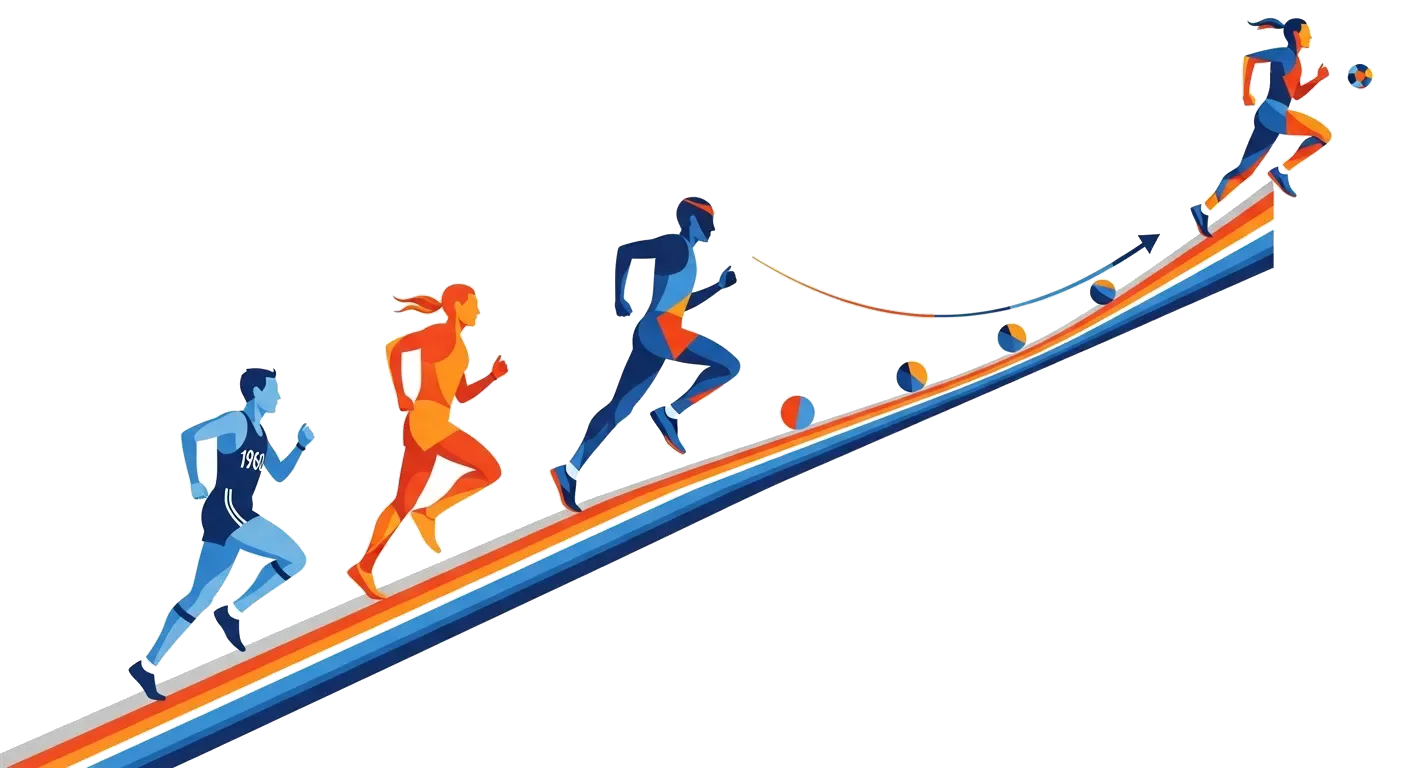
A century after the distance was set at 26.2 miles (42.195 km) (London 1908 Olympics, official standard in 1921), the men's record has lost almost an hour: from 2:55:18 (Johnny Hayes, 1908) to 1:59:30. The progress did not come in a straight line but in steps, at each major breakthrough: scientific training in the 1960s, the arrival of East African runners in the 1990s, carbon plate shoes from 2017.
Men's marathon records: the timeline
The main steps of the men's world record, from the 1908 Olympics to the first official sub-2.
| Year | Athlete | Country | Time | Race |
|---|---|---|---|---|
| 1908 | Johnny Hayes | United States | 2:55:18 | London Olympics |
| 1925 | Albert Michelsen | United States | 2:29:01 | Port Chester |
| 1947 | Suh Yun-bok | Korea | 2:25:39 | Boston |
| 1953 | Jim Peters | United Kingdom | 2:18:40 | Polytechnic Marathon |
| 1960 | Abebe Bikila | Ethiopia | 2:15:16 | Rome Olympics (barefoot) |
| 1967 | Derek Clayton | Australia | 2:09:36 | Fukuoka |
| 1981 | Robert de Castella | Australia | 2:08:18 | Fukuoka |
| 1988 | Belayneh Densamo | Ethiopia | 2:06:50 | Rotterdam |
| 1999 | Khalid Khannouchi | Morocco / United States | 2:05:42 | Chicago |
| 2003 | Paul Tergat | Kenya | 2:04:55 | Berlin |
| 2008 | Haile Gebrselassie | Ethiopia | 2:03:59 | Berlin |
| 2011 | Patrick Makau | Kenya | 2:03:38 | Berlin |
| 2014 | Dennis Kimetto | Kenya | 2:02:57 | Berlin |
| 2018 | Eliud Kipchoge | Kenya | 2:01:39 | Berlin |
| 2022 | Eliud Kipchoge | Kenya | 2:01:09 | Berlin |
| 2023 | Kelvin Kiptum | Kenya | 2:00:35 | Chicago (October 8) |
| 2026 | Sabastian Sawe | Kenya | 1:59:30 | London (April 26), current record |
On April 26, 2026 in London, Kiptum's record fell three times in the same race: Sabastian Sawe won in 1:59:30, Ethiopia's Yomif Kejelcha finished second in 1:59:41 in his first marathon, and Uganda's Jacob Kiplimo third in 2:00:28. Eliud Kipchoge's 1:59:40.2 in Vienna in 2019 never counted as a record: it was a non-competitive exhibition (rotating pacemakers, pace car, drinks from a bike). The full story of the march toward two hours is in our article on the history of the sub-2-hour marathon.
Women's marathon records: two recognized records
Since 2011, World Athletics has kept two women's records: the mixed-race record, where men may act as pacemakers, and the women-only record, set in a race with no men at the start. The women's marathon only joined the Olympics in 1984 (Los Angeles, won by Joan Benoit), which explains a later and steeper progression.
| Year | Athlete | Country | Time | Race |
|---|---|---|---|---|
| 1964 | Dale Greig | United Kingdom | 3:27:45 | Isle of Wight |
| 1971 | Adrienne Beames | Australia | 2:46:30 | Werribee |
| 1980 | Grete Waitz | Norway | 2:25:42 | New York |
| 1985 | Ingrid Kristiansen | Norway | 2:21:06 | London |
| 1998 | Tegla Loroupe | Kenya | 2:20:47 | Rotterdam |
| 2001 | Catherine Ndereba | Kenya | 2:18:47 | Chicago |
| 2003 | Paula Radcliffe | United Kingdom | 2:15:25 | London |
| 2019 | Brigid Kosgei | Kenya | 2:14:04 | Chicago |
| 2023 | Tigst Assefa | Ethiopia | 2:11:53 | Berlin (September 24) |
| 2024 | Ruth Chepngetich | Kenya | 2:09:56 | Chicago (October 13), current record |
| Year | Athlete | Country | Time | Race |
|---|---|---|---|---|
| 2005 | Paula Radcliffe | United Kingdom | 2:17:42 | London |
| 2017 | Mary Keitany | Kenya | 2:17:01 | London |
| 2024 | Peres Jepchirchir | Kenya | 2:16:16 | London |
| 2025 | Tigst Assefa | Ethiopia | 2:15:50 | London |
| 2026 | Tigst Assefa | Ethiopia | 2:15:41 | London (April 26), current record |
Ruth Chepngetich's mixed-race record stands despite the three-year suspension handed down in October 2025: the positive test (hydrochlorothiazide) dates from March 2025, after Chicago, and results before that sample are not annulled. On September 27, 2026 in Berlin, Tigst Assefa held record pace until 40 km before an injury slowed her: she won in 2:11:04, the third-fastest performance in history.
How fast does a world record holder run? Compare with your goal
1:59:30 is 4:33.5 per mile (2:49.9 per km) held for 26.2 miles, or 13.2 mph (21.2 km/h). When Sabastian Sawe crosses the line, here is where a runner who started at the same moment at an even pace would be:
| Marathon goal | Pace per mile (per km) | Distance reached | Time left |
|---|---|---|---|
| 3:00 | 6:51.9 (4:16.0) | 17.4 mi (28.0 km) | 1:00 |
| 3:30 | 8:00.6 (4:58.6) | 14.9 mi (24.0 km) | 1:30 |
| 4:00 | 9:09.2 (5:41.3) | 13.1 mi (21.0 km) | 2:00 |
| 4:30 | 10:17.9 (6:23.9) | 11.6 mi (18.7 km) | 2:30 |
| 5:00 | 11:26.5 (7:06.6) | 10.4 mi (16.8 km) | 3:00 |
In other words, a 4-hour marathoner has barely reached halfway when the record falls. To work out your own pace and splits, use the marathon pace calculator, which also gives the full table of times from 2:00 to 6:00.
The athletes who defined each era
Abebe Bikila, the birth of East African dominance
1960, Rome Olympics. The marathon is run at night. Abebe Bikila, a guard of the Ethiopian emperor, runs barefoot on the cobblestones and breaks the world record in 2:15:16. Four years later in Tokyo, he does it again in shoes with a new record (2:12:11), six weeks after an appendectomy. Bikila opened the East African era of the marathon.
Grete Waitz, pioneer of the women's marathon
The Norwegian won the New York City Marathon nine times between 1978 and 1988 and improved the world record four times. She paved the way for the boom in women's marathon running in the 1980s.
Paula Radcliffe, a record that lasted 16 years
2:15:25 in London in 2003. That time, considered far ahead of its era, stood until Brigid Kosgei in 2019.
Eliud Kipchoge, the master of pacing
Two Olympic titles (Rio 2016, Tokyo 2020), two official world records (2:01:39 in 2018, 2:01:09 in 2022) and the unratified sub-2 in Vienna (1:59:40.2 in 2019): Kipchoge embodies the marathon of the 2010s and 2020s, and his even pacing remains a benchmark.
Kelvin Kiptum, the spark cut short
A late discovery, the Kenyan ran three exceptional marathons in under a year: Valencia (2:01:53, 2022), London (2:01:25, 2023), then Chicago (2:00:35, October 8, 2023), a world record for two and a half years. He died in a road accident in February 2024, aged 24.
Sabastian Sawe, the first official sub-2
The defending London champion went through halfway in 1:00:29 in a group led by pacemakers, then surged after 25 km. He ran the 5 km from 30 to 35 km in 13:54, dropped Kejelcha in the last mile and covered the second half in 59:01: a negative split of a minute and a half, the same strategy we recommend to amateurs. His record was ratified by World Athletics on July 23, 2026.
Technological and methodological breakthroughs
Three major turning points shape the progression:
- 1960s-1970s: daily training, intervals, high mileage (Lydiard, Bowerman). Times drop from 2:20 to 2:08.
- 1990s-2000s: Kenyan and Ethiopian dominance, professionalization, fast courses (Berlin, Chicago, London). From 2:06 to 2:03.
- Since 2017: carbon plate shoes, pacemakers in formation, data-driven training. From 2:02 to 1:59:30.
FAQ: marathon world records
What is the men's marathon world record?
1:59:30, by Sabastian Sawe (Kenya) at the London Marathon on April 26, 2026, ratified by World Athletics on July 23, 2026. He beat Kelvin Kiptum's record (2:00:35, Chicago 2023) by 65 seconds.
What is the women's marathon world record?
2:09:56, by Ruth Chepngetich (Kenya) in Chicago on October 13, 2024, in a mixed race. The women-only record is 2:15:41, by Tigst Assefa (Ethiopia) in London on April 26, 2026.
Who ran the first official sub-2-hour marathon?
Sabastian Sawe, in 1:59:30 in London on April 26, 2026. Yomif Kejelcha also broke the barrier in the same race (1:59:41). Eliud Kipchoge's 1:59:40.2 in Vienna in 2019 is not a record: the event did not follow World Athletics rules.
What pace does the marathon world record holder run?
4:33.5 per mile on average (2:49.9 per km), or 13.2 mph (21.2 km/h) for 26.2 miles. At that pace, 10K takes 28:19 and a half marathon 59:45.
What is the French marathon record?
For men, 2:03:47 by Morhad Amdouni in Seville on February 18, 2024. For women, 2:23:13 by Mekdes Woldu in Barcelona on March 16, 2025.