Achilles tendinopathy in runners: treatment and return to running
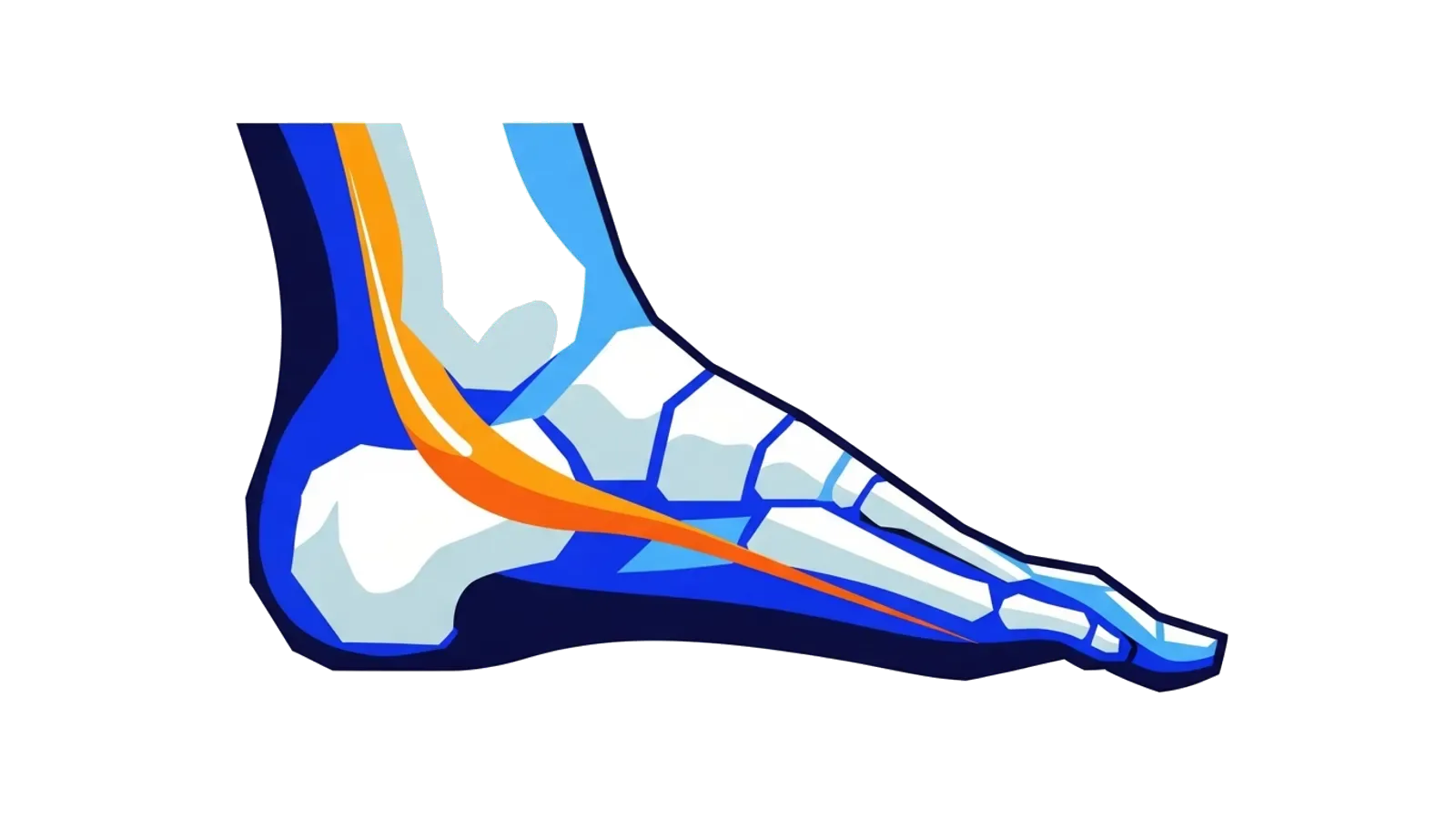
The Achilles tendon is the strongest tendon in the human body: it takes up to 8 times body weight at each stride at fast paces. That strength has a downside: when it gets irritated, it is long, it is sneaky, and it can keep coming back for months if it is not managed properly.
Achilles tendinitis (the everyday term; the exact medical name is Achilles tendinopathy) affects about 10% of regular runners. The good news: a precise protocol, scientifically validated since the 1990s, gives excellent results in 70 to 80% of cases. The bad news: it takes patience and discipline.
How to recognize Achilles tendinopathy
- Pain on the tendon, most often 1 to 2.5 inches (2 to 6 cm) above the heel (the mid-portion form, the most common) or right where it attaches to the heel bone (the insertional form).
- Typical stiffness when getting up in the morning or after sitting for a long time: the first steps are painful and stiff, then it "loosens up" after a few minutes.
- Pain at the start of a run, which may ease during the effort then comes back at the end and the next day.
- Tenderness to touch, sometimes a thickened tendon (a nodule you can feel under your fingers).
- Advanced cases: pain even at rest, when walking, on stairs.
Why it happens
| Cause | Mechanism |
|---|---|
| A sudden rise in volume or intensity | The tendon adapts more slowly than the muscle |
| Sudden hill work or intervals | Maximal pull on the tendon |
| Worn shoes or a drop that is too low | The tendon is stretched beyond what it is used to |
| Stiff or weak calves | Poor shock absorption and energy return |
| Flat feet or overpronation | The tendon is loaded in torsion |
| Returning after an ENT infection or a course of antibiotics (fluoroquinolones) | Temporary tissue fragility |
| Age over 35-40 | Natural aging of the tendon |
What you can do right now
- Cut running immediately: stop completely for 7 to 14 days in the acute phase. Complete rest is not the right long-term strategy, though: see the eccentric protocol below.
- Ice: 10 to 15 minutes after any effort, 2 to 3 times a day in the first days.
- Heel lifts: 0.4 inch (1 cm) in each shoe (running and everyday) for 4 to 6 weeks. This reduces tension on the tendon. Remove them gradually afterwards.
- Calf self-massage with a roller or ball, 5 minutes per leg, avoiding the tendon itself.
- Cross-training: cycling (saddle high to limit ankle flexion), swimming, deep-water running.
The reference protocol: Stanish-Alfredson eccentrics
This is the treatment validated by studies for thirty years. It loads the tendon in a controlled way to stimulate its repair and reorganization. It is done every day for 12 weeks.
Daily protocol:
- Position: on a step, balls of the feet on the edge, heels hanging off.
- Phase 1 (concentric): rise onto the toes of both feet.
- Phase 2 (eccentric): shift all your weight onto the painful leg, then lower very slowly (3 to 4 seconds), letting the heel drop below the level of the step.
- 3 sets of 15 reps with the knee straight (targets the gastrocnemius) + 3 sets of 15 reps with the knee bent (targets the soleus).
- Once this volume is well tolerated, add weight in a backpack and increase gradually.
Important: mild pain (3-5/10) during the exercise is expected and acceptable. Pain above 5/10, or lasting more than 24 hours, means reducing the load. The protocol must be daily and kept up for 12 weeks to work. It is demanding, but it works.
When to see a professional
- Severe pain that stops you putting your foot down normally: rule out a rupture (emergency).
- Pain that persists beyond 6 to 8 weeks of a well-followed protocol.
- A visibly thickened tendon, or a nodule.
- Pain that wakes you at night.
- The insertional form (pain right on the heel): it needs an adapted protocol with a shorter range of motion, to be set up with a physical therapist.
Prevention
- Eccentric calf strengthening as a preventive program: 1 to 2 times a week, 3×15 per leg (pain-free).
- Gentle calf stretches after each run: 30 seconds per muscle, straight leg then bent knee.
- A running cadence of 170 to 180 steps per minute, which lowers peak Achilles tension compared with an overly long stride.
- A stable shoe drop: do not switch abruptly from a 10 mm drop to a 4 mm drop. Any lower drop needs an adaptation period of at least 6 to 8 weeks.
- Strict progression on hill work and intervals: these are the two sessions hardest on the tendon.
Returning to running
Only return when brisk walking is completely pain-free and you tolerate loaded eccentrics without lingering pain. Then follow the 4-week protocol in our article on returning to running after an injury, on soft, flat ground, at a very easy pace. Bring back hills and intervals no earlier than week 8 of running.
Patience: it is long, and that is normal
Tendons have 5 to 10 times less blood supply than muscles, so they heal much more slowly. Count 3 to 6 months for lasting healing, sometimes more for chronic forms. Rushing the steps exposes you to chronic tendinopathy, which can drag on for years. The tendon rewards consistency, not haste.
Related tools
This information is educational and does not replace the advice of a sports doctor or a physical therapist. It was written by the Tempocito editors and has not been reviewed by a named health professional. The figures rely on the scientific and institutional sources listed at the end of the article.
If pain persists, gets worse, is intense or appears at rest, see a health professional.
Sources
- van der Vlist AC, Winters M, Weir A, et al. (2021). Which treatment is most effective for patients with Achilles midportion tendinopathy? A living systematic review with network meta-analysis. Br J Sports Med. 2021;55(5):249-256. Link
- Alfredson H, Pietilä T, Jonsson P, Lorentzon R (1998). Heavy-load eccentric calf muscle training for the treatment of chronic Achilles tendinosis. Am J Sports Med. 1998;26(3):360-366. Link
- Maffulli N, Longo UG, Kadakia A, Spiezia F (2020). Achilles tendinopathy. Foot Ankle Surg. 2020;26(3):240-249. Link
- Martin RL, Chimenti R, Cuddeford T, et al. (2018). Achilles Pain, Stiffness, and Muscle Power Deficits: Midportion Achilles Tendinopathy Revision 2018. Clinical Practice Guidelines. J Orthop Sports Phys Ther. 2018;48(5):A1-A38. Link